
What do I work on?
I haven't found a more compelling framework for thinking about meaningful work—at least not yet.

Work As Hard As You Can. Even though what you work on and who you work with are more important" *- Naval Ravikant
The big question. What should I work on?
For most of us, the first time we really think about this is when we are asked to pick an area of study in University.
This is obviously silly because how are you supposed to know what you want to work on if you haven't worked on anything yet. And thus, in most cases, we choose what we "should" study. What our parents think, what our school advisor thinks is economical etc…
There are certainly exceptions to this pattern. Take the high school student who was passionate about computer science and went on to build something extraordinary, or the marine biology enthusiast who followed their dream and became a scuba instructor in Australia while working to protect the reef. But these are exceptions.
For most of us, we chose the economical route, and then we kind of worked backwards into (hopefully) doing things that we enjoy later in life. In my case, I studied finance, then I did a finance internship and realized I had no interest in trading markets or corporate finance. So I became a realtor instead because I thought I could make money.
This was done haphazardly. I read a book called, "The One Thing" by Gary Keller, and Gary happened to be a realtor.
Not a bad way to explore, but lacking intention. If I got to start over, I’d be more intentional. For example, in high school, I was really interested in scientists and inventors but I didn't come back to these interests for a long time — I'm just coming back to them now — over a decade later.
Lacking direction, I pursued money since it was society's typical measure of success. However, I quickly lost interest in these pursuits and never stayed with them long enough to benefit from the compound effects of sustained focus.
I later learned from Peter Diamandis (a mentor and friend), that those pursing projects with purpose will almost always out compete those doing it for money.
So, I began searching for purpose through various philosophies. Existentialism, Stoicism, Taoism, Viktor Frankl/ Logotherapy, even Tony Robbins.
This gave me valuable internal language to process the universal struggles we all face — but didn’t help with the self discovery piece I was looking for.
So I searched for a framework — something to help me with self discovery.
I explored various personality assessments: Myers-Briggs, The Big Five, Enneagram, DISC, and Wealth Dynamics. Though many were based on Jungian psychology, they proved limiting — focusing mainly on corporate work styles and boxing people into predefined categories for others to evaluate.
These assessments fall short for creators, entrepreneurs, and artists seeking deeper direction. I needed something to illuminate the path already within me — one I knew existed but couldn't yet articulate.
Then I discovered the Japanese concept of ikigai. You may be familiar with its common representation as a Venn diagram showing four overlapping circles: what you love, what you're good at, what can earn you money, and what benefits the world.
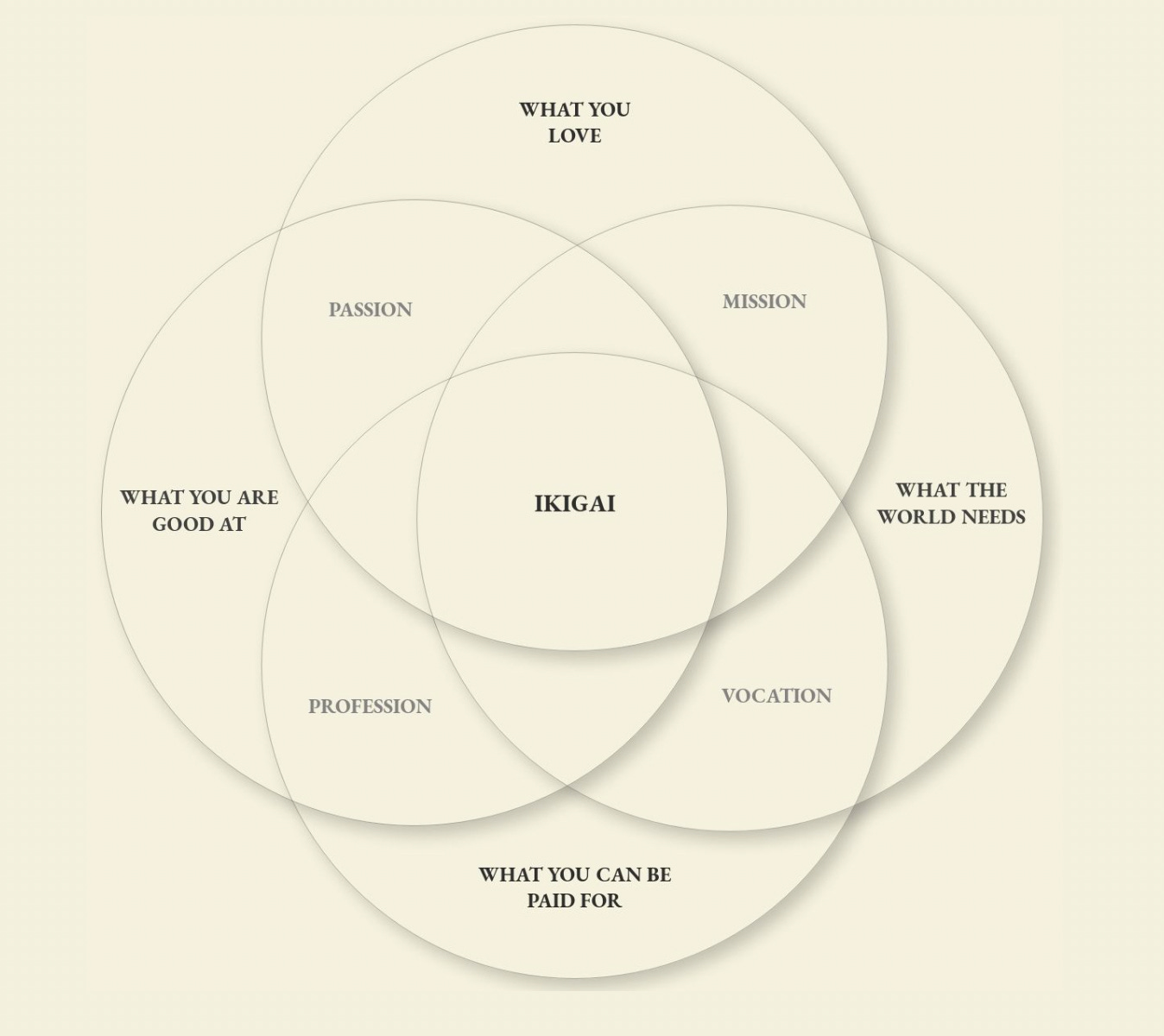
This captivated me — quite a compelling goal right? I haven't found a more appealing framework for thinking about work—at least not yet.
As I learned more about this concept, I learned the diagram was a simplification of the Japanese philosophy, which has a lot more behind it.
My exploration led to a profound realization: this philosophy contains, in its elegant simplicity, a complete framework for living a meaningful life.
Here’s a little teaser with some of my favorite elements:
Find work you love so much that you never want to stop doing it. A pursuit that you'll continue until you leave earth—work not as a means to retire, but as a natural extension of life that enriches it. And it might even make you live longer!
Ichigo ichie (the singular moment). Similar to the widely known concept of "flow state". It says that this unique intersection (your ikigai) opens up a state of complete immersion. A state where time dissolves. It's a feeling you know well if you've experienced it. I believe the kids these days are calling it "locked in". If you want to learn about this I suggest checking out Rian Doris's YouTube channel or the book "Flow" by Mihaly Csikszentmihalyi.
Resilience to adversity. The idea here is that if you find this intersection (your Ikigai), you become more resilient. The Japanese say it's "like a bamboo that bends without breaking" - you become stronger through life's challenges. Similar to a concept popularized by Nassim Taleb called “Antifragile”.
Find your tribe. A strong social circle ****is an important foundation to the philosophy. It can be challenging to develop a circle that nourishes you, and in my personal opinion, sharing your Ikigai is a great way to attract the type of people you want to spend your life with.
Have a light joyful approach towards your pursuits. This really hit me because I find that when I'm lighter and more playful, I'm a lot more effective. This has even been shown on the track, Usain Bolt often talks about being relaxed to go faster.
I'm sharing this with you now because I believe many people can benefit from incorporating Ikigai into their lives.
When I tried to find my own intersections, I spent hours attempting to identify them, but ended up with mediocre results. So, I built a tool that provides an experience similar to other personality assessments.
The tool uses the Ikigai framework to help people map the intersections between their interests, skills, meaningful causes, and potential income sources.
My goal is to introduce more people to this philosophy by making it more immediately useful.
Instead of viewing abstract diagrams, you can explore their own unique ikigai map and use it as a guide to pursue meaningful work and relationships.
This is the first version. I had a lot of fun building it, I hope you find it as useful as I do.
https://www.buildmyikigai.com/
Tyler Donahue